

The People’s Choice Awards presented by Rogers recipients are: Javier Calvo and Javier Ambrossi’s La Bola Negra, Simon Stone’s Elsinore (International), Barry Avrich’s Darlene Love: I Know Where I’ve Been (Documentary), and Matthew Rankin’s Ladies and Gentlemen, Brian Mulroney (Midnight Madness)
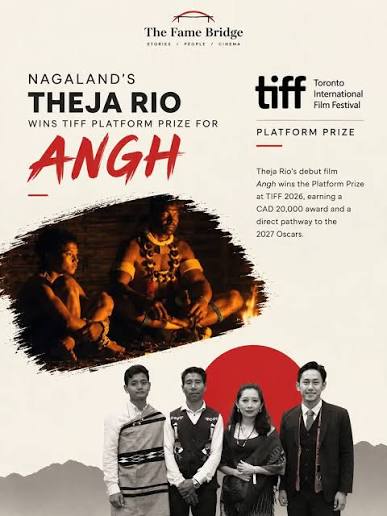
TIFF Platform Prize winner: Theja Rio’s Angh
TORONTO — The Toronto International Film Festival revealed this year’s award winners during a live press conference at TIFF Lightbox today. Among the top honours announced were the People’s Choice Awards, presented by Rogers, voted on by TIFF’s public audience; the Platform Prize, the Festival’s only juried programme; two Canadian feature film awards, Short Cuts, FIPRESCI, and NETPAC awards. In total, 12 awards were handed out, celebrating standout films and breakout talent.
In a historic first this year, winning TIFF’s Platform Prize grants a non-English-language film direct eligibility for Best International Feature Film at the Academy Awards, alongside top winners from five other qualifying festivals.
Audiences can catch this year’s People’s Choice Award–winning films for free at the Lightbox, beginning at 12pm today. https://tiff.net/films?series=special-events&thumbnail
Over the past 11 days, TIFF presented 294 films from 72 countries, welcoming over 800 talent across 98 red carpets. The Festival hosted 2,000 accredited media, close to 7,000 TIFF: The Market delegates, and 279 directors from around the world.
PEOPLE’S CHOICE AWARDS PRESENTED BY ROGERS
Launched in 1978, the TIFF People’s Choice Award, presented by Rogers, celebrates the Festival’s top title as chosen by Toronto’s famously passionate and discerning public audience. The honour now spans four categories: overall, International, Documentary, and Midnight Madness.
People’s Choice Award presented by Rogers:
La Bola Negra, dirs. Javier Calvo and Javier Ambrossi
First runner-up: I Play Rocky, dir. Peter Farrelly
Second runner-up: Being Heumann, dir. Siân Heder
International People’s Choice Award presented by Rogers:
Elsinore, dir. Simon Stone
First runner-up: Possible Love, dir. Lee Chang-dong
Second runner-up: The Assassin(s), dir. Hur Jin-ho
People’s Choice Documentary Award presented by Rogers:
Darlene Love: I Know Where I’ve Been, dir. Barry Avrich
First runner-up: Black Sunflowers, dir. James Marcus Haney
Second runner-up: The Ultra Runner, dir. Mila Aung-Thwin
People’s Choice Midnight Madness Award presented by Rogers:
Ladies and Gentlemen, Brian Mulroney, dir. Matthew Rankin
First runner-up: The Spiral, dir. Paolo Strippoli
Second runner-up: Arrested Memory, dir. SABU
PLATFORM PRIZE
Launched in 2015 and inspired by Jia Zhang-ke’s groundbreaking film, TIFF’s Platform Prize honours filmmakers with strong directorial vision and distinctive storytelling. All films in the programme are eligible for the prize. TIFF’s Platform Prize is one of only six international festival awards with a direct pathway to the Oscars. Building on this newly established status, the 2026 Platform programme expanded to 12 films, with an international five-member jury selecting the winner of the $20,000 CAD prize. This year’s jury was led by President Pablo Trapero, alongside Amma Asante, Sylvia Chang, Luc Déry, and Albert Lee.
Platform Prize:
Angh
dir. Theja Rio | India
Platform jury’s statement: “The Platform Prize goes to Angh. For its refreshing perspective, strength of filmmaking, and deeply resonant portrait of a world. We praise the filmmaker’s vision, audacity and courage.”
Special Jury Award:
Brace Your Heart (Garrat Du Váimmu)
dir. Amanda Kernell | Sweden, Norway, Denmark, Iceland, Bulgaria
Platform jury’s statement: “We would like to recognize Brace Your Heart with an Honourable Mention. For how its apparent simplicity reflects the complex nature of the world today, its powerful central performance and beautiful visual journey.”
SHORT CUTS AWARDS
Short Cuts Awards are presented to the Best International Short Film, Best Canadian Short Film, and Best Animated Short Film, as awarded by the Short Cuts jury. Each of the three winning films will receive a bursary of $10,000 CAD. The 2026 jurors for the Short Cuts Awards are Joecar Hanna, Chris Lavis, and Iris Ng.
Short Cuts Award for Best International Short Film:
MAMMALIA, dir. Elia Kalogianni | Greece, Netherlands
Short Cuts jury’s statement: “We were struck by the audacity of a film willing to expose what we would rather not admit about ourselves and concepts we thought we were comfortable with. Bold, visceral, and formally assured, it explores the toxic relationship we don’t examine enough with those around us. It takes the grotesque and makes it disturbingly relatable, forcing opposing sides of a double standard into the same frame. What first feels extreme slowly reveals itself as something much more unsettling: a reflection of our own behavior, and of a society whose contradictions urgently deserve to be challenged.”
Honourable Mention:
The Spectacular Death of Prisca, dir. Kaelo Iyizoba | Nigeria
Short Cuts jury’s statement: “We wanted to give an Honourable Mention to a film that took us on a completely different kind of ride: a delightful mashup of melodrama, action and comedy that reminded us of the pure joy of making and watching cinema. Executed with remarkable precision in both filmmaking and performance, it turns family dynamics into something heightened, absurd and unexpectedly revealing. We were especially struck by how original it felt without ever seeming to chase originality. Choices that many filmmakers might hesitate to make were handled with such confidence and ease that the film created its own singular tone, full of personality and completely free of pretension.”
Short Cuts Award for Best Canadian Short Film:
Fight Kid, dir. Michael Del Monte | Canada
Short Cuts jury’s statement: “A film that is at once gripping and cautionary, offering a sharp dissection of inherited masculinity and ambition. We were taken by its enigmatic and electric journey, and by the unique way it blurs performance and reality, making it almost impossible to disengage from the screen.”
Honourable Mention:
Almost Pink, dir. Justine Prince | Canada
Short Cuts jury’s statement: “A film that helps us address another shameful and traumatic experience we fear to share. Disturbing but vital, it confronts the sexual exploitation of teenagers and the social and economic forces that allow it to happen. With remarkable confidence, the film builds and sustains an unbearably tense and terrifying atmosphere, demanding that we pay attention to a reality too often kept out of sight.”
Short Cuts Award for Best Animated Short Film:
Into The Betaverse, dirs. Varun Raman, Tom Hancock | United Kingdom
Short Cuts jury’s statement: “This film is a venue where ridiculous meets the profound. It is a surprisingly emotional comedy about friendship and finding love in unexpected places. This confident hybrid of live action and animation is unapologetically primitive and loose. Which, in an era of AI smoothing, that roughness only makes its humanity feel more present.”
Honourable Mention:
Terminal, dir. Alexandre Siqueira | Portugal, Spain, France
Short Cuts jury’s statement: “We shared the joy of discovering a film that knows how to be poetic and surreal without becoming overwhelming. It creates a delicate allegory of death and loss while giving us the space to sit with those emotions. Its animation is crisp and full of detail, but never calls attention to itself at the expense of the story. The style serves the film’s quest to connect rather than competing with it.”
FIPRESCI PRIZE
The FIPRESCI jury awards the International Critics’ Prize, dedicated to emerging filmmakers, to a debut feature film having its World Premiere in TIFF’s Discovery programme. The 2026 FIPRESCI jury members are Pragya Mishra, Cătălin Olaru, Savina Petkova (PhD), Enoe Lopes Pontes (PhD), and Victor Stiff.
FIPRESCI Prize:
Ancestors, dir. David Turpin | Ireland, United Kingdom
FIPRESCI jury’s statement: “In this story of lost people finding each other, we saw an extraordinary command of translating the dreamy landscape of memories and recollections into compassionate cinematic language. It immersed us in someone else’s life, a time of love and turmoil, a past that returns through photographs and memories to haunt, bring longing, and give hope at once.”
NETPAC AWARD
Presented by the Network for the Promotion of Asian Pacific Cinema, the NETPAC Award recognizes films from the Asian and Pacific regions. The jury consists of three international community members selected by TIFF and NETPAC, who award the prize to the best Asian film by a first or second-time feature director. The 2026 NETPAC jury was led by Jury Chairperson Mara Matta, alongside Richard Fung and Panagiotis Kotzathanasis.
NETPAC Award:
Thirteen in Gaza, dir. Hosam Abu Dan | Palestine
NETPAC jury’s statement: “Against unfolding genocide, Thirteen in Gaza by Hosam Abu Dan turns suffering into neither spectacle nor victimhood, but into riveting images of life in all its complexity. A brave, intimate film that announces a major new voice in cinema.”
BEST CANADIAN DISCOVERY AWARD
The Best Canadian Discovery Award celebrates the next generation of filmmakers shaping its future. The award recognizes emerging talent whose first or second feature brings a distinctive voice to the Canadian film landscape. All Canadian first or second feature films in Official Selection are eligible. The winner receives a cash prize of $10,000 CAD. The 2026 Best Canadian Discovery Award Jury members are Zarrar Kahn, Justine Pimlott, and Sophy Romvari.
Best Canadian Discovery Award:
Smudge the Blades, dir. Cody Lightning | Canada
Canadian Discovery jury’s statement: “Smudge the Blades is electric. It carries heart and humour in equal measure, while never shying away from the challenges faced by Indigenous communities caused by the ongoing treatment of Indigenous people and colonization of Indigenous lands. Rooted in joy and resilience, Smudge the Blades challenges familiar genres by placing Indigenous voices at the centre of a story filled with hope, offering a radical path forward. Cody’s deeply empathetic directing and his eye for character, has resulted in a film that is propulsive, funny and furious. An assured sophomore feature about family, ambition — and the transformational power of community.”
Honourable Mention:
The Black Box is Orange, dir. Yuula Benivolski | Canada
Canadian Discovery jury’s statement: “A childhood impacted by settler ideology is unpacked through painful memories and the striking use of archival images. For its sensitive, brave and challenging formal dexterity, showcasing a nuanced depiction of the systematic erasure of Palestinian histories while delicately threading the needle between personal and political, we award The Black Box is Orange with the Honourable Mention for this year’s Discovery Award.”
BEST CANADIAN FEATURE FILM AWARD
The Best Canadian Feature Film Award honours the unique craft and storytelling in Canadian cinema. All Canadian feature films in Official Selection — excluding first or second features — are considered for the award. The winning filmmaker will receive a $10,000 CAD cash prize. The 2026 Best Canadian Feature Film Award jury members are Hubert Davis, Deepa Mehta, and Christina Rogers.
Best Canadian Feature Film Award:
Sunburn, dir. Serville Poblete | Canada
Canadian Feature Film jury’s statement: “Sunburn is a vibrant, funny, and deeply human film that brings a fresh, visceral energy to Toronto. With innovative filmmaking, remarkable performances, and an ensemble of characters who moved us, the film achieves something extraordinary. We are thrilled to recognize Serville Poblete as a young filmmaker with a distinctive voice and a generous vision.”
Honourable Mention:
Man in Motion: The Rick Hansen Story, dir. Adrian Buitenhuis | Canada
Canadian Feature Film jury’s statement: “The Rick Hansen Story is a moving, beautifully crafted film that offers a powerful new perspective on Rick Hansen’s extraordinary journey, while reminding us of the people who are too often left behind.”
Awards descriptions including eligibility can be found at tiff.net/awards. Information on the People’s Choice Award voting process can be found at tiff.net/vote.
The 51st Toronto International Film Festival, presented by Rogers, concludes today. The 52nd edition of the Festival will take place September 9–19, 2027.
—- Supple Magazine reporting for Toronto International Film Festival 2026